





August. 08, 2026
Buying cat litter in bulk is different from choosing a product from a retail shelf. For importers, distributors and private label brands, the main concern is not only whether a sample looks good, but whether the product can maintain stable quality across large and repeat orders.
Before confirming a supplier, buyers should evaluate the product using several practical performance indicators. These checks can help reduce problems related to dust, weak clumping, excessive breakage, inconsistent particle size or unstable packaging after shipment.
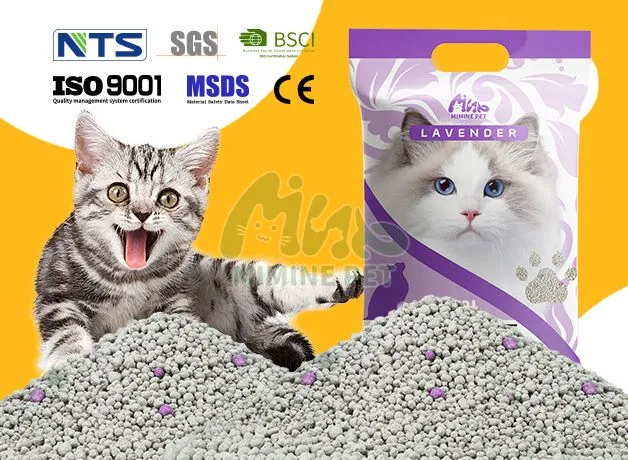
Different cat litter materials should not be evaluated using exactly the same standards.
Common bulk cat litter types include:
Bentonite cat litter
Tofu cat litter
Cassava cat litter
Mixed cat litter
Bentonite products are usually evaluated for clumping, dust, absorption and particle hardness. Tofu and cassava products require more attention to pellet integrity, moisture, absorption and breakage. Mixed cat litter needs to balance the properties of different materials according to the target market.
Before requesting samples, buyers should therefore define the material, target price range, sales channel and required performance.
Particle size influences both product performance and consumer experience.
When inspecting a sample, check whether the granules or pellets are relatively uniform and whether there is excessive fine material at the bottom of the bag.
For bentonite litter, an unstable particle distribution may affect dust, tracking and clumping. For tofu litter, too many broken pellets may indicate insufficient structural strength or damage during handling.
If you are developing private label cat litter, it is better to confirm a specific particle size range rather than simply approving a product by appearance.
“Low dust” is one of the most common claims used in cat litter marketing, but buyers should verify the actual product.
Use the same amount of litter and pour each sample from the same height into identical containers.
Observe:
Visible dust during pouring
Fine powder remaining inside the bag
Dust created when the litter is stirred
Dust after repeated shaking or handling
The last point is important for international buyers. A freshly produced sample may appear clean, but weak particles can break during transportation and create more dust before the goods reach the warehouse.
This is why dust control should be evaluated together with particle strength.
For clumping cat litter, fast reaction is useful, but speed alone is not enough.
Use the same litter depth and the same amount of liquid when comparing samples.
Check:
How quickly the clump forms
How widely the liquid spreads
Whether the clump remains compact
Whether it breaks during scooping
Whether wet residue remains at the bottom
A clump that forms quickly but breaks easily may still create a poor user experience.
For this reason, buyers should compare both clumping speed and clump integrity.
Good absorption does not simply mean that the product can absorb liquid. Buyers should also consider how much litter is required to deal with a specific amount of liquid.
During testing, compare the size of the wet area and the amount of material involved in each clump.
If too much surrounding litter becomes wet, the product may be consumed faster during normal use.
This is particularly relevant for distributors positioning a product around efficiency or longer usage time.
Bulk cat litter goes through repeated handling before reaching the consumer.
Bags may be filled, stacked, palletized, loaded into containers, transported by sea, unloaded and moved again through local distribution.
Weak particles may gradually break during this process.
A simple test is to shake or repeatedly handle the sample and then compare the amount of broken material and dust.
For mineral cat litter, particle hardness can strongly affect landed product quality. For plant-based litter, pellet strength and moisture stability are also important.
Fragrance should not be confused with odor control.
A strong fragrance may initially make a product smell pleasant, but it does not automatically mean that the litter performs well after use.
When testing scented cat litter, consider:
Fragrance intensity
Fragrance consistency
Whether the scent is too strong
Stability during storage
Suitability for the target market
For private label programs, fragrance can also be customized according to local consumer preferences.
Manufacturers such as Mimine supply multiple fragrance and formulation options for bentonite, tofu, cassava and mixed cat litter, allowing buyers to match product positioning more closely with their market.
Tracking is affected by particle size, shape, weight and surface texture.
Very fine or lightweight particles may perform well in some areas but can be carried outside the litter box more easily.
Buyers should therefore test actual tracking rather than selecting particle size only according to appearance.
There is no universal best particle size. The right specification depends on the balance between clumping, tracking, dust and consumer preference.
Packaging is particularly important for bulk cat litter because the product is relatively heavy.
A weak bag can create leakage, damaged handles or split seams during shipping and warehouse handling.
When reviewing private label packaging, check:
Bag material
Sealing strength
Handle design
Moisture resistance
Package weight
Print quality
Barcode and label information
Pallet or carton configuration
Packaging size should also match the sales channel. Small bags may be more suitable for e-commerce or trial sales, while larger bags can be more efficient for wholesale and high-consumption users.
The most important purchasing question is often not “Is this sample good?” but:
Can the supplier reproduce this quality in every production batch?
Before placing a bulk order, ask how the manufacturer controls:
Raw materials
Particle size
Moisture
Dust
Clumping
Fragrance
Packaging
Net weight
Batch inspection
Mimine, for example, uses production inspection and retained batch samples as part of its quality control process. This type of system gives repeat-order buyers a clearer reference when checking consistency between shipments.
Instead of approving a sample with a general comment such as “quality is acceptable,” record the key requirements.
A useful approval sheet may include:
| Item | Requirement |
|---|---|
| Material | Bentonite, tofu, cassava or mixed |
| Particle | Size or pellet specification |
| Dust | Target quality level |
| Clumping | Speed and strength |
| Absorption | Required performance |
| Fragrance | Type and intensity |
| Moisture | Acceptable condition |
| Packaging | Weight, bag structure and artwork |
| Branding | Private label information |
This makes communication easier when production begins.
The lowest-priced sample is not always the lowest-cost option for a distributor.
Excessive dust, weak clumps, damaged packaging, inconsistent fragrance or unstable batches can lead to complaints, returns and weaker repeat sales.
Before placing a bulk cat litter order, test the product under realistic conditions and confirm the specification with the supplier.
Mimine supports sample evaluation for buyers sourcing bentonite, tofu, cassava and mixed cat litter, including private label projects. Providing the destination market, preferred material, packaging size and required performance before sampling can help the manufacturer recommend a more suitable product from the beginning.
Related News
March. 19, 2026
Which cat litter is the most environmentally friendly?
June. 05, 2026
Bulk Tofu Cat Litter: A Complete Guide for Pet Owners and Wholesale Buyers
April. 22, 2026
Clumping, Organic, and Non-Clumping Cat Litter Solutions
Hot Products

Blue Diamond Starry Sky Cat Litter


Dust-Free Bentonite Cat Litter


Activated Carbon Tofu Cat Litter


water-soluble granular cassava cat litter


Get Free Samples and Quotes

Contact Mimine Pet
After you complete the information, our staff will contact you to send the catalog. And support to get free samples.


