





September. 09, 2026
Particle size is one of the most important specifications in cat litter manufacturing, but it is often overlooked when buyers evaluate a product. Two cat litters made from similar raw materials can provide very different user experiences simply because their particle size distributions are different.
Particle size can influence how quickly liquid is absorbed, how firmly clumps form, how much litter sticks to a cat's paws, how much dust is generated, and how the product feels during use.
For importers, distributors, retailers, and private label brands, understanding the relationship between particle size and product performance can help when selecting specifications, comparing samples, and developing a new cat litter formula.
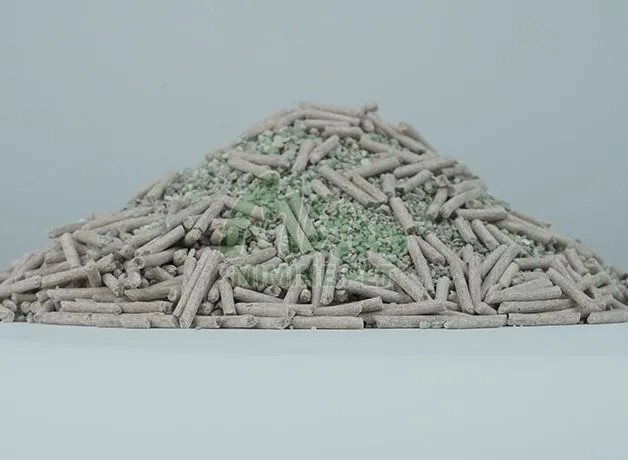
Cat litter particle size refers to the dimensions of individual granules, pellets, or particles within the finished product.
A commercial cat litter product usually contains particles within a defined size range rather than particles that are all exactly the same size. Manufacturers may use screening and classification processes to control this distribution and remove excessive fines or oversized particles.
Particle size can be described in several ways, including:
Average particle size
Minimum and maximum particle size
Particle size distribution
Percentage of fine particles
Percentage of oversized particles
Granule uniformity
The target specification depends on the material and the intended product performance.
Bentonite litter, tofu litter, cassava litter, and mixed formulas may require different particle structures because their raw materials and manufacturing processes behave differently.
Particle size affects several performance characteristics at the same time.
The most important relationships include:
Particle size and clumping speed
Particle size and clump strength
Particle size and liquid absorption
Particle size and tracking
Particle size and dust
Particle size and litter-box texture
Particle size and product consumption
This means particle size should not be evaluated as an isolated specification.
A very fine particle may provide certain performance advantages but may also increase tracking or dust. A larger particle may reduce tracking but change the way liquid moves through the litter.
The objective is therefore not simply to make particles smaller or larger. The goal is to establish a particle size distribution that provides an appropriate balance of performance characteristics.
Fine and large particles behave differently when they come into contact with moisture and when they are handled during normal use.
Fine particles provide a relatively large surface area in relation to their volume.
Depending on the material and formulation, this can support rapid interaction with liquid and contribute to faster clump formation.
However, very fine particles can also be more easily carried by a cat's paws or disturbed during pouring and scooping.
Potential characteristics include:
Fast liquid interaction
Fine and compact clumps
Greater surface contact
Potentially higher tracking
Greater sensitivity to dust control
Larger granules generally provide a different physical experience.
They may be less likely to stick to paws and can reduce the amount of material carried away from the litter box. However, larger particles can change liquid penetration and the structure of the resulting clump.
Potential characteristics include:
Lower tracking potential
Larger individual granules
Different paw-feel
Potentially slower liquid penetration
Different clump structure
Neither particle size category is universally better. The appropriate specification depends on the product material, formula, and target market.
For clumping cat litter, particle size can influence how quickly liquid spreads through the litter and how the particles bind together.
When liquid contacts a clumping material such as bentonite, the particles interact with moisture and begin forming a wet mass.
Smaller particles can provide more contact points around the wet area. This may contribute to faster and more compact clump formation when the formulation has suitable absorption and swelling characteristics.
However, clumping performance is not determined by particle size alone.
Other important variables include:
Raw material composition
Absorption capacity
Swelling characteristics
Particle hardness
Moisture content
Binder or formulation components
Particle shape
Liquid volume
Litter depth
This is why simply reducing particle size does not automatically produce stronger clumps.
A well-designed product needs to balance particle size with the other physical and formulation parameters.
Clumping speed and clump strength are related but different performance indicators.
A litter may form a clump quickly but produce a fragile structure that breaks during scooping.
Particle size distribution can influence the spaces between particles and the way the wet material consolidates.
A balanced particle distribution can help create a stable clump structure, while excessive fines or oversized particles may produce less consistent results.
For B2B buyers, it is therefore useful to test both:
How quickly the clump forms
Whether the clump remains intact during scooping
A product specification should not focus on clumping speed alone.
Tracking occurs when litter particles are carried outside the litter box, usually on a cat's paws or fur.
Particle size is one of several factors that influence tracking.
Very small particles can be more easily transferred because they can become trapped between paw pads or attached to fur.
Larger particles may reduce this effect, although particle shape and surface texture are also important.
For example, two products with similar particle sizes can have different tracking performance if one has smoother, more rounded granules while the other has irregular or broken particles.
Other tracking factors include:
Particle weight
Particle shape
Surface texture
Particle hardness
Moisture
Cat behavior
Litter-box design
This is why particle size should be considered together with particle shape and physical strength.
Dust and particle size are closely related, but they are not exactly the same thing.
Very small particles and fines can become airborne during:
Bag filling
Transportation
Pouring
Scooping
Stirring
Litter-box cleaning
This is particularly important for mineral cat litter.
A product may have an appropriate average particle size but still produce excessive dust if it contains too many weak particles or fines.
For this reason, manufacturers need to control both the target particle size range and the percentage of fine material.
Screening and dust-removal processes are important parts of this control.
Mimine's existing quality guidance also recommends checking both particle uniformity and excessive fine material when evaluating bulk cat litter samples.
Particle size can also influence the way liquid moves through a litter bed.
Smaller particles generally create smaller spaces between particles, while larger particles create larger voids.
This affects how liquid spreads through the material.
However, absorption performance ultimately depends on the properties of the raw material as well as particle size.
For example, bentonite and plant-based litter do not absorb liquid in exactly the same way. Tofu and cassava products also have different pellet structures and moisture characteristics.
Therefore, particle size should be optimized for the specific material rather than copied from another type of cat litter.
Consumers do not evaluate particle size directly. They experience its effects.
A cat and its owner may notice:
How the litter feels under the cat's paws
How much litter is tracked around the home
How dusty the product feels during pouring
How easily urine forms a scoopable clump
How much litter remains after cleaning
How often the litter needs to be replenished
This makes particle size an important product-development parameter.
For private label brands, the right particle specification can contribute to a product's overall identity even when the raw material is similar to competing products.
Particle size should never be considered independently from particle shape.
A product can contain particles within the same size range but have significantly different physical characteristics depending on whether the particles are:
Rounded
Irregular
Broken
Cylindrical
Bar-shaped
Flattened
For example, tofu cat litter may be produced in different pellet shapes, while bentonite products may use different granule structures.
The combination of size and shape affects paw feel, tracking, dust, packing density, and handling characteristics.
This is particularly important when developing a customized private label formula.
A consistent particle size distribution can make product performance more predictable.
If a bag contains a mixture of very fine particles, medium granules, and oversized pieces, the product may behave differently from one batch to another.
Inconsistent particle distribution can affect:
Clumping
Tracking
Dust
Appearance
Packing density
Consumer perception
For importers and distributors, consistency is especially important because a product must perform similarly across repeated orders.
A single good sample is not enough if subsequent production batches have significantly different particle distributions.
Particle size is typically controlled through several stages of production.
Depending on the material and formula, manufacturers may use:
Raw material preparation
Crushing or grinding
Granulation or pelletizing
Drying
Screening
Dust removal
Particle classification
Final quality inspection
Screening is particularly important because it separates particles according to defined size ranges.
The manufacturing process should also minimize unnecessary particle breakage after screening.
If particles are too fragile, transportation and handling can create additional fines even when the product initially meets the particle-size specification.
For B2B buyers, particle size should be evaluated systematically rather than judged only by visual appearance.
A practical evaluation can include:
Spread a sample on a clean surface and examine the distribution of fine, medium, and large particles.
Compare samples from different batches rather than evaluating only one bag.
Look at the amount of powder collected at the bottom of the package.
Shake or handle the sample repeatedly and check whether additional particles break down.
Test clumping, tracking, dust, and absorption under consistent conditions.
This provides a more complete picture than measuring particle size alone.
Private label brands should start with the desired product performance rather than choosing a particle size arbitrarily.
Consider the following questions:
Is fast clumping a priority?
Is low tracking more important?
Is a soft paw feel part of the product positioning?
Does the market require low dust?
Is the formula mineral-based or plant-based?
Will the product be sold through e-commerce or physical retail?
Will the product be transported over long distances?
What level of price positioning is required?
The answers can help determine the appropriate particle structure.
For example, a product positioned around fast clumping may require a different particle specification from one designed primarily around low tracking.
For manufacturers and professional buyers, particle size should not be treated as a cosmetic characteristic.
It is a technical specification that can influence multiple product-performance indicators.
A useful product specification may define:
Target particle size range
Acceptable size deviation
Fine-particle percentage
Oversized-particle percentage
Particle shape
Particle strength
Moisture content
Dust performance
Defining these parameters before mass production can make communication between brands and manufacturers much easier.
Cat litter particle size affects far more than the appearance of the product.
It can influence clumping behavior, tracking, dust generation, absorption, handling, and the overall user experience.
However, there is no single particle size that is ideal for every cat litter product.
The right specification depends on the raw material, formulation, particle shape, manufacturing process, target performance, and market requirements.
For importers, distributors, and private label brands, particle size should therefore be evaluated as part of a complete product-performance system rather than as an isolated number.
By controlling particle size distribution, particle strength, fines, and uniformity, manufacturers can create more consistent cat litter products and reduce performance differences between production batches.
Related News
November. 25, 2025
How to Switch Your Cat to a New Litter Type
August. 26, 2026
How to Reduce Dust, Breakage and Packaging Problems in Bulk Cat Litter Shipping
August. 28, 2025
Top Private Label Cat Litter Manufacturers
Hot Products

Blue Diamond Starry Sky Cat Litter

Raw Ore Mixed Bentonite Cat Litter | OEM Manufacturer – Mimine Pet


Dust-Free Bentonite Cat Litter


Activated Carbon Tofu Cat Litter


water-soluble granular cassava cat litter


Get Free Samples and Quotes

Contact Mimine Pet
After you complete the information, our staff will contact you to send the catalog. And support to get free samples.


