





September. 09, 2026
Cat litter granule shape is more than a visual difference. The shape of individual granules can influence surface contact, liquid distribution, clumping behavior, tracking, dust generation, breakage, packing density, and the overall user experience.
For importers, distributors, retailers, and private label brands, understanding different granule shapes can make it easier to specify products and compare samples from different manufacturers.
Common cat litter formats include rounded or spherical granules, broken or irregular particles, and bar-shaped pellets. Each structure has different physical characteristics and may be better suited to particular formulations and product requirements.
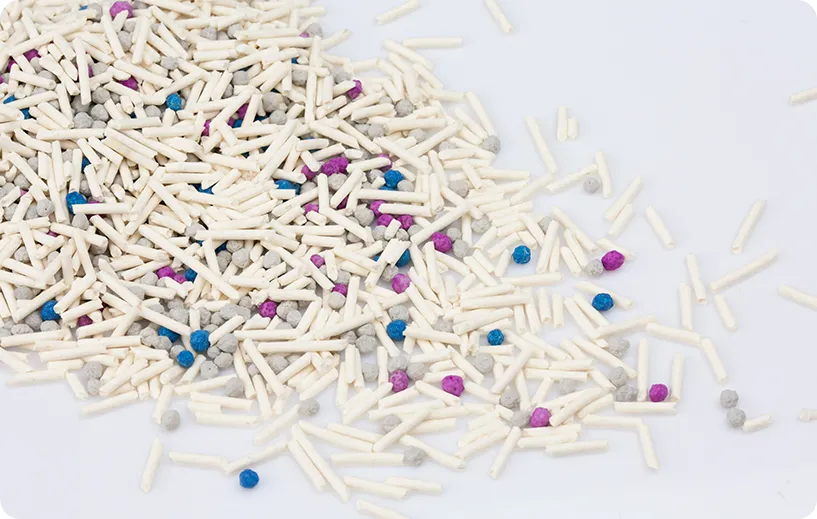
Granule shape describes the physical geometry of individual particles or pellets in a finished cat litter product.
Common formats include:
Round or spherical granules
Broken or irregular granules
Bar-shaped pellets
Cylindrical pellets
Mixed or specialty shapes
Shape is different from particle size.
Particle size describes how large a granule is, while shape describes its physical form.
Two products can have a similar particle-size range but behave differently because their particles have different shapes and surface structures.
This is why particle size and particle shape should be evaluated together when developing or purchasing cat litter.
Granule shape can affect several aspects of cat litter performance, including:
Liquid contact
Absorption behavior
Clump formation
Tracking
Dust
Particle breakage
Packing density
Paw feel
Product appearance
Transportation stability
The effect is not identical for every type of cat litter.
A rounded bentonite granule and a bar-shaped tofu pellet are produced from very different materials and manufacturing processes, so their shape should be evaluated in the context of the complete formulation.
Round or spherical granules are commonly used in mineral cat litter products.
Their relatively smooth shape can provide a consistent surface profile and a uniform appearance.
Rounded granules may offer several potential characteristics:
Consistent particle flow
Smooth physical texture
Lower tendency to interlock mechanically
Uniform visual appearance
Potentially lower mechanical friction between particles
The actual performance depends on the material, surface treatment, particle hardness, and size distribution.
Mimine, for example, offers spherical bentonite products alongside broken bentonite products, demonstrating how different physical structures can be developed from the same general material category.
Broken granules have irregular shapes and often result from crushing or controlled processing of larger raw-material pieces.
This structure can provide greater exposed surface area and more irregular contact points between particles.
For clumping mineral litter, this can influence how liquid interacts with the granules.
Broken bentonite products are commonly positioned around fast clumping and absorption because the irregular structure can provide substantial surface contact. Mimine's broken bentonite product, for example, uses irregular crushed granules in the 1–3.5 mm and 0.5–2.5 mm ranges.
However, irregular particles should not automatically be considered superior.
If the particles are too fragile, handling and transportation can create additional fines and dust.
Bar-shaped pellets are particularly common in plant-based cat litter, including tofu and some cassava-based formulas.
Instead of forming individual rounded granules, the material is processed into elongated pellets.
A bar-shaped structure can provide:
A distinctive product appearance
A relatively consistent pellet format
Easy visual identification
Different paw-feel characteristics
Different packing behavior
A recognizable private-label product format
Tofu cat litter commonly uses this type of pellet structure. Mimine's product range includes bar-shaped tofu litter as well as broken tofu litter.
The appropriate pellet dimensions depend on the formula, raw materials, extrusion or pelletizing process, and desired performance.
One of the most important differences between rounded and irregular particles is their contact with surrounding material and liquid.
Rounded particles generally have smoother external surfaces and fewer sharp edges.
Broken particles have irregular surfaces and edges that can increase the amount of exposed material.
For absorbent cat litter, this difference can influence how quickly liquid interacts with the material.
However, surface area is only one factor.
Absorption also depends on:
Raw material properties
Porosity
Moisture content
Particle size
Particle density
Formulation
Processing method
Therefore, granule shape should not be used by itself to predict absorption performance.
Clumping is one of the most important performance characteristics for bentonite and other clumping cat litter products.
When liquid contacts the litter, the particles begin interacting with moisture and forming a wet mass.
Particle shape can influence how these particles pack together during clump formation.
Irregular particles may create more mechanical contact points, while rounded particles may create a different packing structure.
The resulting clump depends on the combination of:
Particle shape
Particle size
Absorption capacity
Swelling characteristics
Moisture content
Particle hardness
Formulation
This is why two products with the same nominal particle size can produce different clump structures.
Clumping speed is only one part of clumping performance.
A commercially successful cat litter also needs to produce clumps that remain stable during scooping.
Granule shape can influence the physical structure of the wet mass.
A suitable combination of particle shape, size, and material properties can help create a compact clump that is easier to remove without excessive breakage.
For B2B buyers, clump evaluation should therefore include both:
Clumping speed
Clump integrity
Mimine's bulk-quality guidance similarly recommends evaluating both how quickly a clump forms and whether it remains compact during scooping.
Tracking occurs when litter particles leave the litter box on a cat's paws or fur.
Granule shape can influence tracking because it affects how particles interact with paw pads and fur.
Very small particles can become trapped between paw pads, while elongated or irregular particles may behave differently depending on their surface texture and weight.
However, shape alone does not determine tracking.
Important factors include:
Particle size
Particle shape
Particle weight
Surface texture
Particle hardness
Moisture
Cat behavior
For this reason, tracking tests should compare complete products rather than relying only on the visual appearance of individual particles.
Dust is closely related to particle strength and the amount of fine material in a product.
Shape can influence how particles break during:
Production
Packaging
Handling
Transportation
Pouring
Scooping
Irregular particles with weak structures may generate additional fines when subjected to repeated impact.
Bar-shaped pellets can also break if the pellet structure is not sufficiently strong.
This is especially important for export cat litter.
Mimine's shipping guidance notes that transportation can cause broken granules and increased dust, making particle strength and product structure important for international distribution.
For bar-shaped tofu or plant-based pellets, shape consistency is closely connected to mechanical strength.
A pellet may look uniform when it leaves the production line but break during:
Bag filling
Pallet stacking
Container loading
Ocean transportation
Warehouse handling
As pellets break, the percentage of smaller particles increases.
This can change the product's appearance and potentially affect dust and tracking.
Therefore, a private label buyer should evaluate not only the initial pellet shape but also the product's condition after simulated handling.
Different shapes occupy space differently.
Spherical particles tend to behave differently during packing compared with irregular particles or elongated pellets.
This can influence:
Bulk density
Package volume
Transportation efficiency
Bag dimensions
Warehouse storage
Shipping cost calculations
For international buyers, this relationship is particularly relevant because cat litter is a relatively heavy product.
A change in granule shape can therefore affect both product performance and logistics.
Cats interact directly with the physical structure of their litter.
The shape and texture of granules can affect how the litter feels under the paws.
Rounded particles may provide a different tactile experience from sharp-edged broken particles.
Bar-shaped pellets provide another type of surface structure.
For private label brands, paw feel can become part of product positioning, especially when developing premium or specialty formulas.
However, consumer preferences can vary between markets and individual cats.
Product testing is therefore more useful than assuming one shape will work universally.
Tofu cat litter is commonly produced in pelletized formats because plant-based raw materials can be processed into defined shapes.
Common formats include:
Bar-shaped tofu litter
Broken tofu litter
Fine tofu particles
Mixed tofu formulas
Bar-shaped pellets provide a recognizable product format, while broken tofu can provide a finer particle structure.
Mimine's tofu product range includes both bar-shaped and crushed formats, along with customized granule-size and texture options.
This gives private label brands flexibility when developing different product lines.
Bentonite cat litter is commonly available in both rounded and irregular forms.
Rounded bentonite products can provide a uniform appearance and consistent granule geometry.
Broken bentonite products use irregular particles and can be processed into different size ranges.
Mimine's product range includes both spherical bentonite and broken bentonite formats, showing how shape can be used as a product-development variable within the same material category.
The appropriate choice depends on the target balance between clumping, tracking, dust, absorption, and product positioning.
Bar-shaped and broken formats are not simply two different appearances.
They are usually associated with different manufacturing approaches and may create different physical properties.
| Feature | Bar-Shaped Pellets | Broken Granules |
|---|---|---|
| Typical materials | Tofu, cassava, plant-based blends | Bentonite, tofu, mixed formulas |
| Particle geometry | Elongated | Irregular |
| Visual consistency | Usually high | More variable |
| Surface structure | Relatively defined | Irregular |
| Breakage behavior | Depends on pellet strength | Depends on particle hardness |
| Common product positioning | Plant-based and specialty litter | Clumping and absorbent formulas |
These are general tendencies rather than universal rules. Actual performance depends on formulation and manufacturing quality.
When comparing the three major formats, buyers should look beyond shape.
| Factor | Round | Broken | Bar-Shaped |
|---|---|---|---|
| Geometry | Spherical or rounded | Irregular | Elongated |
| Common application | Mineral litter | Mineral and mixed litter | Plant-based litter |
| Surface structure | Relatively smooth | Irregular | Defined pellet surface |
| Clumping behavior | Formulation-dependent | Often designed for strong contact | Formulation-dependent |
| Tracking | Size and surface dependent | Size and weight dependent | Pellet size and surface dependent |
| Dust | Mainly affected by fines and strength | Sensitive to breakage | Sensitive to pellet integrity |
| Packing | Relatively uniform | More variable | Depends on pellet dimensions |
| Product appearance | Uniform | Natural/irregular | Distinctive |
The table should be used as a framework for product evaluation rather than as a ranking of shapes.
Manufacturing technology plays an important role in achieving consistent particle geometry.
Depending on the product, the production process may involve:
Raw material preparation
Crushing or grinding
Mixing
Granulation or pelletizing
Drying
Screening
Dust removal
Surface treatment
Final inspection
Packaging
Different shapes require different process controls.
For broken mineral litter, crushing and screening are particularly important.
For bar-shaped plant-based litter, mixing, extrusion or pelletizing, drying, and pellet integrity are critical.
A buyer may approve a sample based on its appearance, but the more important question is whether the same shape can be reproduced across production batches.
Inconsistent granule shape can result in differences in:
Product appearance
Clumping
Dust
Tracking
Packing density
Consumer experience
For private label programs, shape should therefore be included in the product specification.
Instead of simply writing “tofu cat litter” or “bentonite cat litter,” a purchasing specification can define:
Material
Particle size
Granule shape
Acceptable size deviation
Fine-particle percentage
Moisture
Dust level
Strength
Packaging requirements
This creates a clearer reference for both the buyer and manufacturer.
B2B buyers can use a simple evaluation process when comparing samples.
Look at whether the particles are consistently round, irregular, or bar-shaped.
Determine whether a significant percentage of particles differ from the target format.
Shape should always be evaluated together with size distribution.
Look for powder and broken particles at the bottom of the package.
Shake and handle the sample to determine whether granules or pellets break easily.
Compare clumping, absorption, tracking, and dust under consistent conditions.
Evaluate more than one batch if the product is intended for long-term private label supply.
This approach provides a better picture of production consistency than visual inspection alone.
There is no universal best cat litter shape.
The right format depends on the product's target characteristics and market positioning.
A buyer should consider:
Raw material
Target particle size
Clumping requirements
Absorption requirements
Tracking expectations
Dust-control requirements
Transportation conditions
Packaging format
Target retail price
Consumer preferences
For example, a private label brand developing a plant-based product may evaluate bar-shaped pellets, while a mineral litter brand may compare rounded and broken granules.
The key is to select the physical structure together with the desired performance.
Cat litter granule shape is an important product-development variable that affects more than appearance.
Round, broken, and bar-shaped formats can create different physical characteristics in terms of surface contact, packing, tracking, dust, clumping, and handling.
However, shape should never be evaluated independently.
Particle size, material composition, particle strength, moisture, processing technology, and formulation all contribute to the final product performance.
For importers, distributors, and private label brands, defining granule shape as part of a complete product specification can help improve batch consistency and make supplier communication more precise.
The most useful approach is not to ask which shape is universally best, but which combination of shape, size, material, and formulation best matches the intended product performance and target market.

Previous: None

None Cat Litter Particle Size: How It Affects Clumping, Tracking and User Experience
Related News
March. 19, 2026
Which cat litter is the most environmentally friendly?
May. 18, 2026
How to Use Bentonite Cat Litter Properly: Essential Tips for Cat Owners
August. 28, 2025
Top Private Label Cat Litter Manufacturers
Hot Products

Blue Diamond Starry Sky Cat Litter

Raw Ore Mixed Bentonite Cat Litter | OEM Manufacturer – Mimine Pet


Dust-Free Bentonite Cat Litter


Activated Carbon Tofu Cat Litter


water-soluble granular cassava cat litter


Get Free Samples and Quotes

Contact Mimine Pet
After you complete the information, our staff will contact you to send the catalog. And support to get free samples.

