





October. 10, 2026
When evaluating cat litter performance, absorption is one of the most important factors buyers consider. However, two terms are often confused: absorption rate and absorption speed.
Although they are closely related, they describe different aspects of how cat litter interacts with liquid. Understanding the difference helps manufacturers improve product performance and helps wholesalers, distributors, and private label brands make better purchasing decisions.
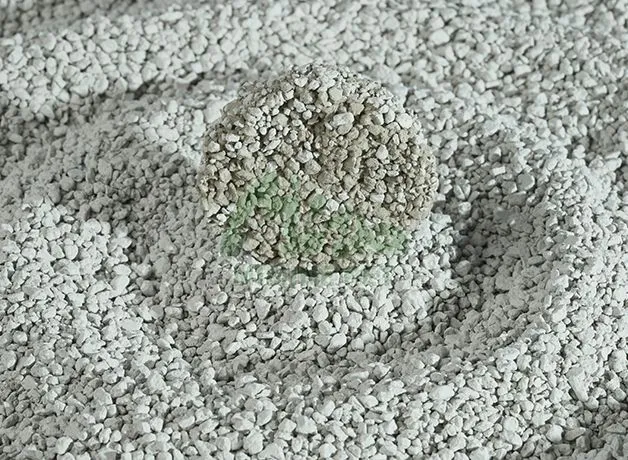
Absorption rate refers to the amount of liquid a cat litter product can absorb relative to its own weight.
It is commonly expressed as a percentage or a weight ratio.
For example, if 100 grams of cat litter absorbs 250 grams of liquid, its absorption capacity is 250%.
A higher absorption rate generally means the product can hold more liquid before becoming saturated.
This characteristic is particularly important for cat litter users because it can influence product consumption, replacement frequency, and overall usage efficiency.
Different materials have different absorption capacities. Bentonite relies on its mineral structure, while tofu and cassava cat litter use plant-based materials with different moisture-absorbing properties.
Absorption speed refers to how quickly cat litter takes in liquid after contact.
Unlike absorption rate, which measures the amount of liquid absorbed, absorption speed focuses on the time required for absorption.
For example, two cat litter products may both absorb 200% of their weight in liquid, but one may absorb the liquid within a few seconds while the other takes considerably longer.
The faster-absorbing product may help reduce liquid pooling on the litter surface and improve the overall user experience.
Absorption speed is influenced by particle structure, porosity, material composition, and manufacturing processes.
The main difference is what each measurement evaluates.
| Comparison | Absorption Rate | Absorption Speed |
|---|---|---|
| Meaning | Amount of liquid absorbed | Time required to absorb liquid |
| Main Focus | Absorption capacity | Absorption efficiency over time |
| Measurement | Percentage or weight ratio | Seconds or minutes |
| Higher Value | Generally indicates greater capacity | Not necessarily better; shorter time is preferable |
| Main Benefit | Helps evaluate liquid-holding capacity | Helps evaluate how quickly liquid is absorbed |
In simple terms, absorption rate answers the question: How much liquid can the cat litter absorb?
Absorption speed answers: How quickly can it absorb the liquid?
Both characteristics are important when evaluating overall cat litter quality.
Several factors influence absorption rate and absorption speed.
Raw Material Composition: Different materials have different natural absorption properties. Bentonite, tofu, and cassava cat litter each have distinct structures and liquid-handling characteristics.
Particle Size: Particle size affects the contact area between cat litter and liquid. Smaller particles may provide greater contact area, while excessively fine particles can affect product handling and dust levels.
Porosity: The internal pore structure influences how liquid enters and spreads through individual particles.
Manufacturing Process: Grinding, granulation, drying, and screening can all affect the final particle structure and absorption performance.
Moisture Content: Excess moisture in finished products may affect their ability to absorb additional liquid during use.
When sourcing cat litter from manufacturers, buyers should evaluate both absorption rate and absorption speed rather than relying on a single performance indicator.
A practical evaluation process includes:
Measure Absorption Capacity: Weigh a dry sample, expose it to a defined amount of liquid, and measure liquid uptake using a consistent testing method.
Test Absorption Time: Record how long the product takes to absorb a specified amount of liquid under controlled conditions.
Check Clumping Performance: For clumping cat litter, evaluate clump formation, strength, and ease of removal.
Evaluate Overall Quality: Consider dust levels, granule consistency, moisture content, and product stability.
For accurate comparisons, testing conditions such as liquid type, temperature, sample weight, and observation time should remain consistent.
A high absorption rate does not always mean faster absorption, and fast absorption does not necessarily mean greater overall capacity.
A high-quality cat litter product should balance absorption capacity, absorption speed, clumping performance, dust control, and ease of cleaning.
At Mimine Pet, we manufacture bentonite, tofu, cassava, and mixed cat litter for wholesalers, distributors, and private label brands worldwide.
Through product formulation, granulation, drying, and quality inspection, we focus on maintaining consistent product performance to meet different market requirements.
Whether you are sourcing bulk cat litter or developing a private label product, understanding absorption rate and absorption speed can help you select the right formulation for your target market.
Contact Mimine Pet to explore our wholesale cat litter and OEM/ODM manufacturing solutions.

Previous: None

None Cat Litter Granule Shape: Round, Broken and Bar-Shaped Formats Explained
Related News
September. 22, 2026
Cat Litter Granule Shape: Round, Broken and Bar-Shaped Formats Explained
November. 09, 2026
Clumping Strength in Cat Litter: What Determines Firm and Stable Clumps?
March. 19, 2026
Which cat litter is the most environmentally friendly?
Hot Products

Blue Diamond Starry Sky Cat Litter

Raw Ore Mixed Bentonite Cat Litter | OEM Manufacturer – Mimine Pet


Dust-Free Bentonite Cat Litter


Activated Carbon Tofu Cat Litter


water-soluble granular cassava cat litter


Get Free Samples and Quotes

Contact Mimine Pet
After you complete the information, our staff will contact you to send the catalog. And support to get free samples.

